


Linking Solid Waste Management to Sustainable Development Goals (SDGs)
- Njiru_Barbara

- Aug 25, 2019
- 3 min read
Updated: Sep 18, 2019

Waste management is a cross-cutting issue and a global challenge that affects and impacts on various sub-sectors of sustainable development within the three domains of sustainability: economy, ecology, and society. Waste management is well entrenched within the Sustainable Development Goals (SDGs) and reflected explicitly in several goals and targets, including those addressing health, water, cities and human settlements, and responsible consumption and production. Moreover, they relate implicitly to the goals on poverty, oceans, decent work, climate change, and while less pronounced, their contribution is also important in areas such as agriculture, education, and gender equality. The principles shaping the current practices of solid waste management activities in cities and urban centers goals are similar to those represented by the Agenda 2030 goals and their respective targets. These principles, as well as the forces, are in some way centered around the domain of sustainability[1]. The target of SDG 11.6 aims for cities to reduce the adverse per capita environmental impact of cities, by paying special attention to air quality and municipal and other waste management with indicator 11.6.1 being the proportion of urban solid waste regularly collected and with adequate final discharge out of total urban solid waste generated by cities. SDG 12 on "Sustainable Production and Consumption" targets among other things, environmentally sound management of all waste through prevention, reduction, recycling, reuse and the reduction of food waste. Moreover, other global adopted agendas such as the New Urban Agenda (NUA) explicitly outlines the commitment by governments to ensure environmentally sound management and minimization of all waste". Mainstreaming the sound management of waste within the national, sub-national and city development priorities is therefore vital to achieving the Sustainable Development Goals (SDGs).
High potential exists for policy coherence in the SDG implementation and national, sub-national and local level development priorities. To exploit it, identifying and assessing synergies between waste management and sustainable development policies to avoid or manage trade-offs is vital. The complexity of the connections between waste management and the SDGs creates a challenge for conventional structures and processes for decision-making. New approaches at the global, national and sub-national levels that integrate horizontal and vertical decision-making and increase policy coherence are essential to avoid implementation inefficiencies and to maximize the desired outcomes. Failing such integration, the complex and interlinked hazards and risks of waste will continue to cause adverse impacts on the environment, human health, and economic development. Consequently, translating the national government commitments to practical and sustainable actions at the local level needs the support of a network of actors with local authorities taking the lead to maximize partnership opportunities.
Some Facts and Figures
Globally, urban population increased to more than 50% of the world's total population in 2015 and will rise further to approximately 70% of the total by 2050. Majority of the population growth will be concentrated in developing countries. The urban population in Africa is projected to treble from 470 million in 2015[2] to 1.2 billion in 2050, making Africa the continent with the highest urban population growth[3]. As an inseparable unit this development, cities produce an ever-growing amount of municipal solid waste (MSW). Globally, the World Bank estimates that the amount of MSW generated by urban areas is growing even faster than the rate of urbanization.
By 2002, there were 2.9 billion urban residents who generated about 0.64 kg of MSW per person per day.
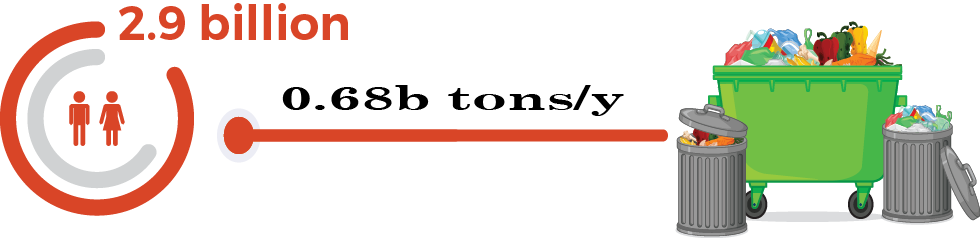
In 2012, there were about 3 billion urban residents each generating 1.2 kg per day (1.3 billion tons per year),

and with the urban population projected to reach about 4.3 billion by 2025 and with each resident generating about 1.42 kg of MSW everyday total MSW will reach 2.2 billion tons by then [4].

In many low-income countries, MSW disposal is a neglected area and a major environmental health hazard. The disposal cost of large quantities of waste is often beyond the financial capacities of cities and municipalities. There is also poor institutional capacity and low political will to address the problem. Many low-income countries lack the facilities for safe disposal of MSW and uncontrolled dumping is the common disposal practice in these countries.

The thematic connection between solid waste management and the SDGs, are outlined in subsequent separate sections. The sections will begin with the explicitly reflected goals (SDGs) (health, water, cities, and human settlements, and responsible consumption and production. Followed by the implicitly reflected goals on poverty, oceans, decent work, climate change, and while less pronounced, their contribution is also important in areas such as agriculture, education, and gender equality.
Reference
[1] Wilson, D.C.; Rodic, L., (2017). Resolving Governance Issues to Achieve Priority Sustainable Development Goals Related to Solid Waste Management in Developing Countries
[2] United Nations, Department of Economic and Social Affairs, Population Division (UNDEA) (2014). World Urbanization Prospects. Available from esa.un.org/unpd/wup.
3] United Nations, Department of Economic and Social Affairs, Population Division (UNDEA) (2008). World Urbanization Prospects: The 2007 Revision. Executive Summary. Available from http://www.un.org/esa/ population/publications/wup2007/2007WUP_Highlights_web.pdf.
[4] https://siteresources.worldbank.org/INTURBANDEVELOPMENT/Resources/336387 1334852610766/What_a_Waste2012_Final.pdf
Comments